

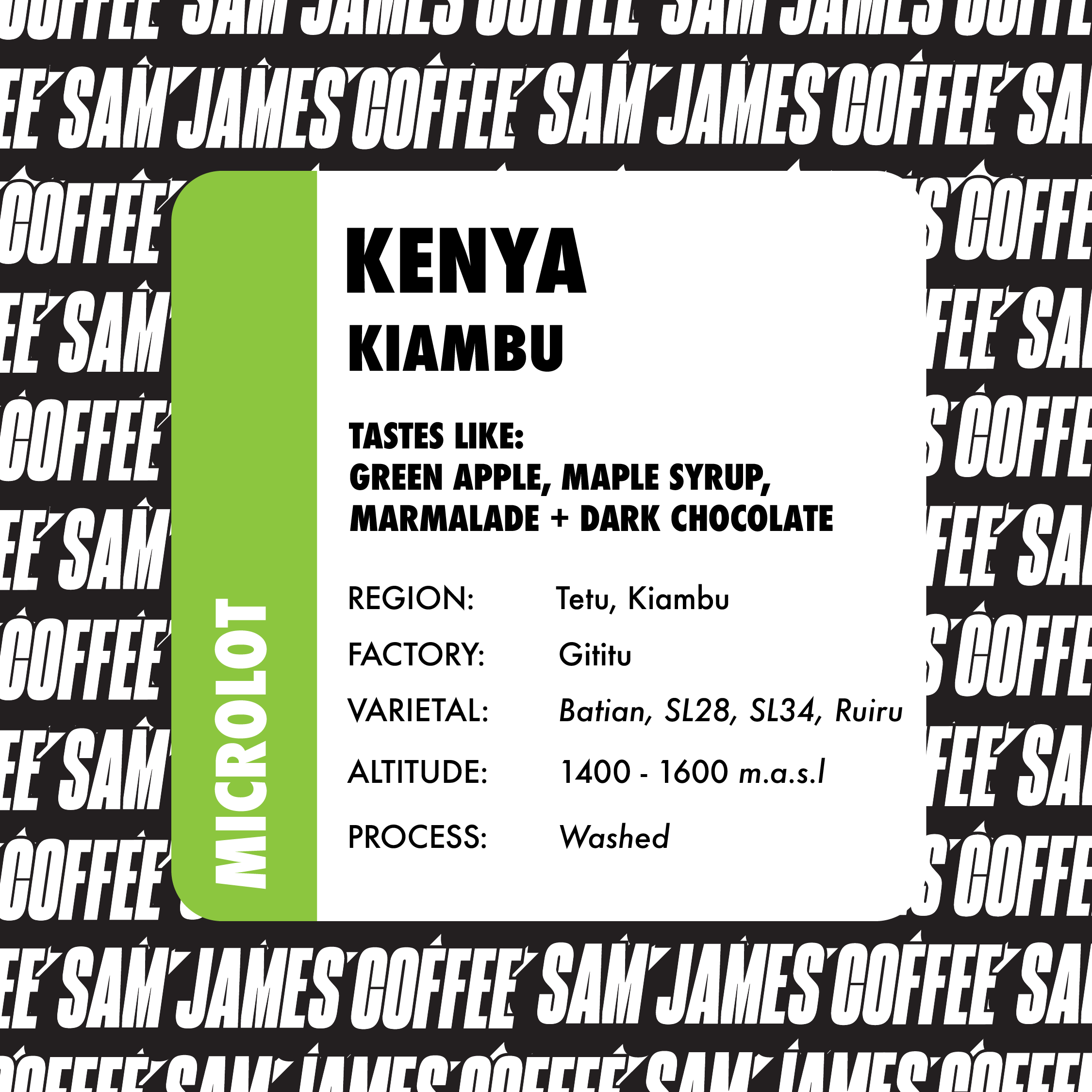

Tastes like
Green Apple
Maple Syrup
Marmalade
Dark Chocolate
Green apple, maple syrup, marmalade, and dark chocolate. A rare microlot from Gititu.
Crisp and juicy, with a sharp green apple acidity up front and maple sweetness right behind it. Bittersweet marmalade fills the middle and the finish lands long on dark chocolate. Fewer than 100 bags, picked from hundreds of Kenyan lots on the cupping table.
Brew it your way
Made for filter. Bold on espresso. On filter at 1:16, the green apple and marmalade come through clean and the maple sweetness fills out the middle. Let the cup cool a little and the dark chocolate shows up in the finish. As espresso it’s bright and syrupy, so pull it at 1:2.2 and let it run toward 33 seconds to round off the acidity. Pick your brewer for the full recipe.
Espresso
Grind
Fine
Ratio
1:2.2
Time
28 to 33s
Temp
96°C
Coffee in
18g
Espresso out
40g
Home or pro? On a home machine, pull 1:2.2. With pro equipment and good water, tighten it to 1:2. In our shops that means 9 bars, remineralized RO water and an 18g VST basket.
Bigger basket On a 20g basket, go hotter, push to 9.25 bars and let it run 30 to 36 seconds. Smaller basket, drop to 8.75 bars and run it shorter.
Coffee maker
Grind
Medium
Ratio
1:17
Time
Auto
Water
Filtered
Coffee
29g
Water
500g
One mug is about 250g of water
Check the shower head Watch it next time you brew. If the water doesn’t cover the whole bed of coffee, you’re wasting coffee. It’s the most important part of the machine.
French press
Grind
Coarse
Ratio
1:15
Time
5 min
Temp
98°C
Coffee
33g
Water
500g
One mug is about 250g of water
One pour The press loses heat fast, so add all the water at once. It keeps agitation down too.
Blade grinder? It makes bitter fines and big chunks that never extract. Let us grind it for you instead.
Kalita Wave
Grind
Med fine
Ratio
1:16
Time
3 min
Temp
94°C
Coffee
16g
Water
250g
One mug is about 250g of water
Draining slow? Lift the paper filter. On the stainless Kalita it can stick and block one of the three holes. Pour more slowly, or use a Hario Drip Assist.
Aeropress
Grind
Fine
Ratio
1:16
Time
4 min
Temp
80°C
Coffee
15g
Water
240g
One cup, up to the number 4 circle
Upside down Put the plunger in and stand it on its end. Add coffee and water, cap it with a filter and let it steep for four minutes. Flip it onto your cup and press slowly.
Why 80°C? Hotter water for that long gives you a muddy bed that’s hard to press.
Kenya
AA MicrolotRegion
Tetu, Kiambu
Factory
Gititu
Co-op
Aguthi FCS
Altitude
1400–1600 MASL
Process
Washed
Variety
SL28, SL34, Ruiru 11, Batian
The coffee
Kenya tastes like nowhere else, and this microlot shows exactly why. That snap of acidity, the juicy body, the way sweet and tart sit side by side in the same sip. During the harvest, Kenyan factories blend each day’s cherry deliveries into a single day lot. Our importer’s buyer lives in Kenya through the season to cup them, and only the best are bought as microlots of fewer than 100 bags. This is one of them, an AA, the grade reserved for the largest, densest beans. Green apple and marmalade bring the brightness, maple syrup rounds it out, and dark chocolate anchors the finish so the acidity never runs away from you.
Origin
Gititu sits in Tetu, in Kiambu, the highest producing coffee region in Kenya. High rainfall and cool highland temperatures let the cherry ripen slowly, and most of the coffee grows in the uplands on rich red volcanic soil, between Mount Kenya and the Aberdare Range at 1400 to 1600 metres. Kiambu is famous for the bright, citrusy acidity that put Kenyan coffee on the map, and this lot has it in spades. Most growers here farm between an eighth and a quarter of a hectare, so almost nobody processes at home. Instead they deliver ripe cherry to a local factory, the Kenyan name for a washing station, where it’s sorted and processed together.
The factory
Gititu is one of four factories run by the Aguthi Farmers Cooperative Society. Aguthi has 4000 members, a committee of seven elected by the farmers, and about 60 permanent staff who handle cherry intake, payment, and processing. Around 800 of those members deliver to Gititu, and the average farm has about 300 trees, which makes a lot this good a real team effort. The factory runs several seepage tanks to keep used water away from clean water, protecting both the coffee and the land around it. The varieties are Kenyan classics. SL28 and SL34 are famous for their juicy, high toned acidity, while Ruiru 11 and Batian were bred in Kenya to stand up to leaf rust and berry disease without giving up cup quality.
Process
Washed, the Kenyan way. Ripe cherry is depulped the same day and fermented in open concrete tanks for 24 to 48 hours. It’s washed clean through channels, then soaked underwater for another 12 to 72 hours, a step you rarely see outside Kenya. That soak is a big part of why these coffees taste so clean and so bright. From there it dries slowly on raised beds in the mountain air.

